Adam Fisher Back to Home
Strategic Whitepaper • October 2025

Atlas: The Enterprise Intelligence Platform

A unified intelligence layer that connects customer behavior, organizational knowledge, and regulatory awareness—making every AI tool, every agent, and every decision informed by complete enterprise context.

Author Adam Fisher
Focus Enterprise AI Strategy
Status POC Validated
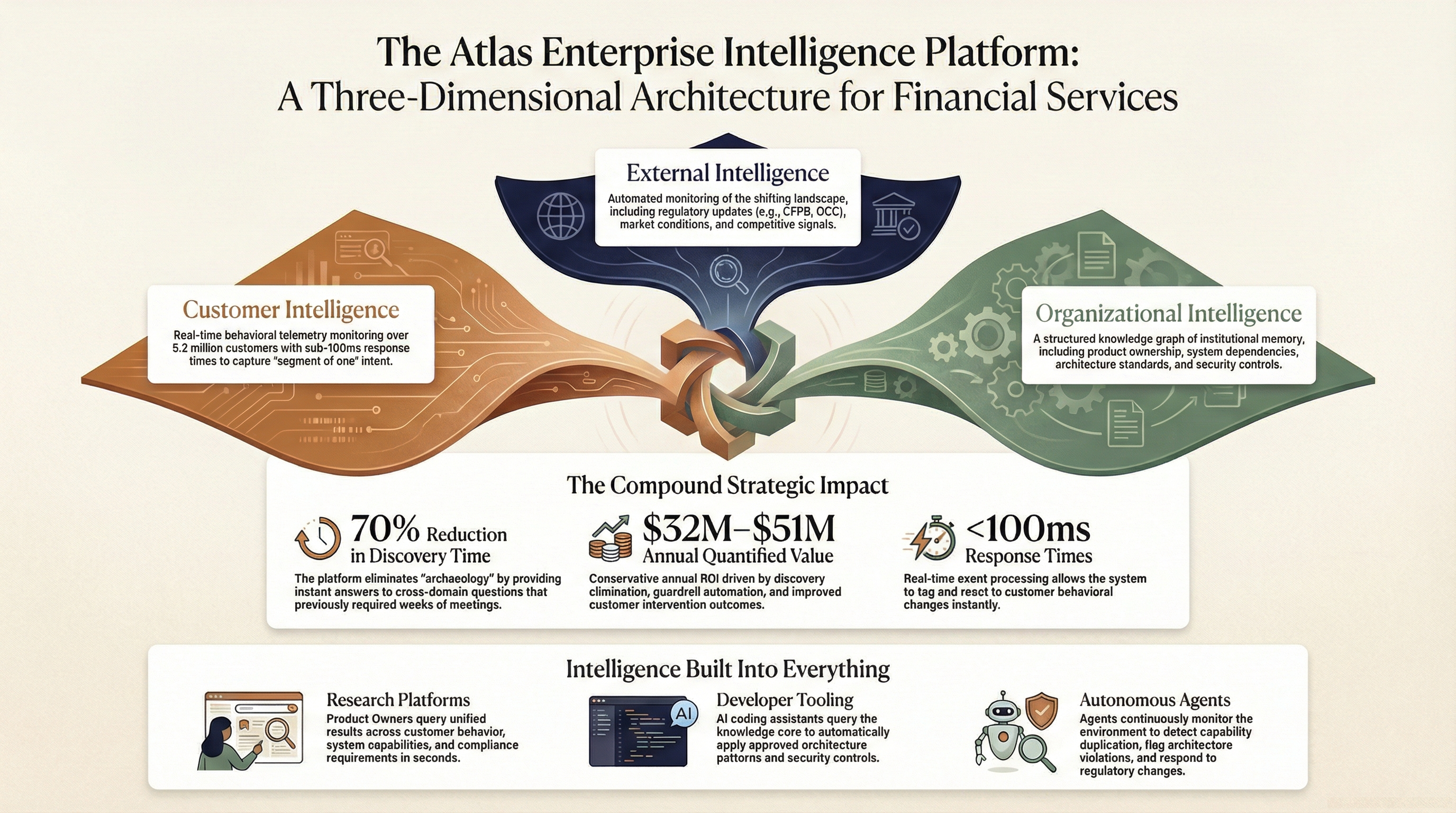
Atlas Enterprise Intelligence Platform - A Three-Dimensional Architecture showing Customer Intelligence, External Intelligence, and Organizational Intelligence converging into a unified platform
$100M+
Annual discovery costs
currently incurred
70%
Reduction in discovery
time with Atlas
5.2M
Customers monitored
in real-time
<100ms
Response time for
behavioral queries
01 — The Vision

Intelligence That Spans the Enterprise

The question isn't whether we can afford to build this. The question is: what does it cost us every day that we don't have it?

Imagine an organization where every product is conceived with complete context. Not built in isolation and integrated later—designed from day one with awareness of customer behavior patterns, existing capabilities, regulatory requirements, and enterprise standards.

Product Owners don't spend months discovering what exists; they start with full visibility into who the customer is, what they're doing, what we already have, and what constraints apply.

Every customer interaction is informed by real behavior

Not quarterly research summaries that are outdated before they're published—real-time intelligence showing what customers are doing right now, which ones are struggling, which ones are about to leave.

Every business decision connects customer needs to organizational capability

Not assembled through weeks of cross-functional meetings—instantly visible. "Which customers are affected by this change?" Answered in seconds.

This isn't a tool. It's an operating model. Intelligence that spans three dimensions—what we know about our customers, what we know about our organization, and what we know about our regulatory landscape—unified and accessible through every platform our people use.

02 — The Architecture

Three Intelligence Dimensions

Each dimension delivers standalone value. Connected, they create exponential impact.

👤

Customer Intelligence

Real-time behavioral signals, journey state, risk indicators, preferences, and segment membership. Living intelligence that changes as customers act—not static profiles updated quarterly.

🏛️

Organizational Intelligence

Product ownership, system dependencies, architecture standards, security controls, compliance requirements, risk frameworks, patterns, and decisions—all structured, connected, and queryable.

🌐

External Intelligence

Regulatory shifts, market conditions, competitive landscape. Context that shapes what we can and must do—connected to the customers it affects and the capabilities that must respond.

🔍

Semantic Search

Find conceptually similar work, patterns, and documentation. Discover connections that weren't explicitly linked because semantic similarity reveals the relationship.

🔗

Knowledge Graph

Structural precision for explicit relationships. "What depends on what?" "Who owns this?" Traverse connections with certainty.

🤖

Agent Infrastructure

Autonomous agents that act on intelligence continuously—proactive interventions, duplication detection, compliance monitoring, architecture enforcement.

03 — Built Into Everything

Infrastructure, Not Destination

This intelligence layer isn't a destination people visit. It's infrastructure that powers every tool they already use.

Research Platforms

When a Product Owner asks "show me everything relevant to hardship enrollment modernization," they get customer behavior data, systems, ownership, compliance mappings, past decisions, and similar patterns—in seconds, not months.

Customer-Facing AI

When a customer in financial distress reaches out, the AI knows their behavioral history, their relationship, the programs they're eligible for, and the compliance requirements governing what can be offered—creating personalized, compliant responses without human assembly.

Developer Tooling

When Claude Code helps a developer implement a payment feature, it already knows the customer segments affected, the architecture patterns, the security requirements, the compliance constraints, the similar implementations elsewhere—not because the developer asked, but because the intelligence layer provides context before every response.

// Developer asks Claude Code for help
Developer: "Help me implement payment retry logic for ACH failures"

// Claude Code queries Knowledge Core automatically
Context Retrieved:
  → Architecture Standard: ADR-47 "ACH Retry Standard"
  → Security Requirement: "PAN masking in all logs"
  → Compliance: "Nacha guidelines for retry timing"
  → Pattern: "payment-gateway/retry-handler.java"
  → Similar: 3 implementations across 2 teams

// Result: Organization-specific answer, correct on first try
Response: Implementation following all standards automatically
04 — Customer Intelligence

Real-Time Behavioral Understanding

Customer Intelligence monitors millions of customers in real-time, capturing behavioral signals as they occur and maintaining a continuously updated understanding of each customer's state.

Behavioral Tagging

Every customer action generates events. The platform processes these events in under 100 milliseconds, applying business rules to determine what behavioral tags should be added or removed from each customer's profile.

Tag Category Examples Purpose
Engagement high_digital_engagement, app_primary_channel Understand channel preferences
Risk Indicators payment_struggle_pattern, autopay_disabled Identify distress signals
Lifecycle State new_customer_first_90_days, approaching_payoff Know journey position
Product Interest viewed_lease_options, explored_payment_relief Detect intent early

The "Segment of One" Model

Each customer has a unique combination of behavioral tags that describe their specific state. Rather than assigning customers to static segments, the platform treats each customer as a dynamic individual whose intelligence profile changes as their behavior changes.

When a customer's tags indicate payment_struggle_pattern + high_digital_engagement, the system knows: this customer is having payment difficulty but actively uses digital channels. The intervention is digital payment arrangement options surfaced proactively—not a collections call.

05 — The Compound Effect

More Than the Sum of Parts

When connected, the value multiplies. Each dimension makes the others more valuable.

Product Development: Complete Context from Day One

Without Atlas: Product Owner spends 6 weeks discovering what exists, who owns it, what compliance applies. Discovers conflicts mid-development. Timeline: 6-9 months.

With Atlas: Queries return customer behavioral data, current capabilities, compliance requirements, similar implementations—instantly. Timeline: 3-4 months.

Regulatory Response: Hours Instead of Weeks

Without Atlas: Compliance drafts memo, teams manually inventory affected systems through meetings, assemble implementation plan. Timeline: 6-8 weeks.

With Atlas: System auto-maps affected capabilities, owning teams, customer impact. Jira tickets created with full context. Timeline: 2-3 days.

Enterprise Intelligence Dashboard

Customers Monitored
5.2M
At-Risk Customers
87,000
Auto-Interventions (24h)
1,247
Discovery Queries
4,892
Avg Response Time
89ms
Compliance Status
100%
06 — Competitive Advantage

The Proprietary Moat

Competitors can buy the same AI tools. Claude, GPT, Gemini—they're available to everyone. The models are commoditizing. Capabilities that seemed magical last year are table stakes this year.

Competitors cannot buy organizational intelligence. The relationships between systems, the decisions made and why, the patterns that work in specific context, the customer behaviors unique to specific products—this is proprietary knowledge that only exists through years of operation.

What's Encoded Creates the Moat

A competitor can replicate the architecture in months. They cannot replicate years of organizational learning encoded in the intelligence layer.

07 — Implementation

The Path Forward

Phase 1 • Q1

Foundation

Build core intelligence infrastructure. Deploy knowledge graph and semantic search. Pilot ingestion from key systems. Prove query patterns work with domain experts.

Phase 2 • Q2

Integration

Connect intelligence layer to pilot tools—research platforms, developer tooling. Expand knowledge coverage organization-wide. Integrate Customer Intelligence feed.

Phase 3 • Q3

Autonomous Agents

Deploy agents that act on intelligence continuously. Proactive customer intervention, capability duplication detection, compliance change response, architecture enforcement.

Phase 4 • Q4

Enterprise Scale

Expand across all business units and product lines. Full organization coverage. All development teams using intelligence-enhanced tools. Quantified ROI validation.

08 — The Economics

Return on Investment

Conservative estimates based on industry benchmarks and validated projections.

Discovery Elimination $3-4M
Guardrail Automation $1.7M
Customer Intelligence $19-31M
Connection Value (Incremental) $5-10M
Compound Productivity $3.8M
Year 1 Investment -$1.95M
Conservative Annual Impact $32-51M
Metric Traditional Approach With Atlas Improvement
Discovery Time per Initiative 4-6 weeks Minutes 70-80% reduction
Regulatory Response Time 6-8 weeks 2-3 days 90%+ faster
Code Review Rework Rate ~30% <10% 60-70% reduction
Customer Intervention Response 20-30 minutes 5 minutes 75%+ faster
Product Concept to Production 6-9 months 3-4 months 50% faster

This is the difference between AI tools and AI strategy

Between scattered point solutions and unified intelligence. Between powerful in isolation and understanding the enterprise. The advantage goes to whoever escapes the status quo first.